Also Written by: Janvi Patidar
Introduction
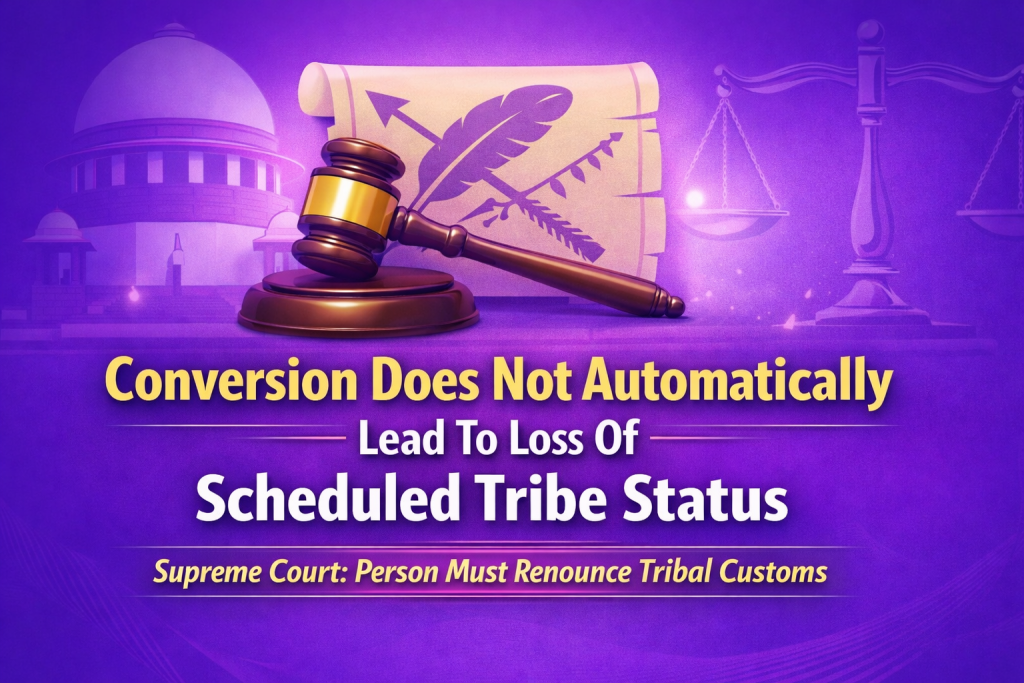
In a significant clarification of constitutional law, the Supreme Court of India has held that conversion does not automatically lead to loss of Scheduled Tribe status. The ruling draws a critical distinction between Scheduled Castes (SCs) and Scheduled Tribes (STs), particularly in how religious conversion impacts their legal recognition.
This judgment not only resolves an important legal ambiguity but also reinforces the socio-cultural foundation underlying tribal identity in India.

Background of the Case
The Supreme Court bench comprising Justice Prasant Kumar Mishra and Justice Manmohan was hearing a case involving a pastor originally belonging to the Madiga caste, who had converted to Christianity.
The petitioner had filed a complaint under the Scheduled Castes and Scheduled Tribes (Prevention of Atrocities) Act. However, the Andhra Pradesh High Court held that upon conversion to Christianity, he ceased to be a member of a Scheduled Caste under the Constitution (Scheduled Castes) Order, 1950, which restricts SC status to Hindus, Sikhs, and Buddhists.
The Supreme Court upheld this position for Scheduled Castes—but went further to clarify the law regarding Scheduled Tribes.
SC vs ST: A Crucial Constitutional Distinction
A key takeaway from the judgment is the fundamental difference between SC and ST status:
1. Scheduled Castes (SCs)
- Governed by Article 341 of the Constitution
- Subject to religion-based restrictions
- Limited to Hindus, Sikhs, and Buddhists
2. Scheduled Tribes (STs)
- Governed by Article 342
- No religion-based exclusion
- Identity based on tribal characteristics, not religion
This distinction forms the backbone of the Court’s reasoning that conversion does not automatically lead to loss of Scheduled Tribe status.
Why Conversion Alone Is Not Decisive for ST Status
The Court emphasized that tribal identity is not merely religious, but deeply rooted in:
- Customary practices
- Social organization
- Community life
- Cultural continuity
- Acceptance by the tribal community
Relying on the precedent in State of Kerala v. Chandramohan (2004), the Court reiterated that tribes are distinct social groups, often defined by shared traditions, governance systems, and ways of life.
Therefore, conversion alone cannot be the sole criterion to determine whether a person has lost their tribal identity.
When Can ST Status Be Lost?
While conversion is not decisive, the Court clarified that Scheduled Tribe status may be lost in specific circumstances:
- If a person completely renounces tribal customs and traditions
- If there is assimilation into another religion’s social and cultural practices
- If there is loss of recognition by the tribal community
In such cases, the “foundational basis” of tribal identity is considered eroded.
Fact-Specific Determination: No Mechanical Rejection
Importantly, the Supreme Court warned against mechanical rejection of ST claims based solely on conversion.
Instead, it held:
- Each case must be fact-specific
- Authorities must examine continuity of tribal traits
- Community acceptance plays a decisive role
Conversely, if a person continues to follow tribal customs—or is re-accepted by the community—their claim to ST status cannot be denied automatically.
Also read: https://vidhigya.com/blog/paternity-vs-maternity-leave-india-legal-editorial/
Legal and Social Significance of the Judgment
This ruling has far-reaching implications:
1. Protection of Tribal Identity
It recognizes that tribal identity is cultural and social, not merely religious.
2. Prevents Misuse of Technicalities
Authorities cannot deny ST benefits solely on the basis of conversion.
3. Strengthens Constitutional Interpretation
Reaffirms the distinct intent behind Articles 341 and 342.
4. Impacts Atrocities Act Cases
Determines eligibility under the SC/ST (Prevention of Atrocities) Act.
Conclusion
The Supreme Court’s ruling firmly establishes that conversion does not automatically lead to loss of Scheduled Tribe status, marking a progressive step in constitutional jurisprudence.
By prioritizing cultural continuity and community recognition over religious identity, the Court has ensured a more nuanced and just approach to determining tribal status in India.
Ultimately, the judgment underscores that identity cannot be reduced to a single factor—it must be understood in its full social and cultural context.
Case Reference
Chinthada Anand v. State of Andhra Pradesh & Ors. SLP (Crl.) No. 9231/2025