By Janvi Patidar
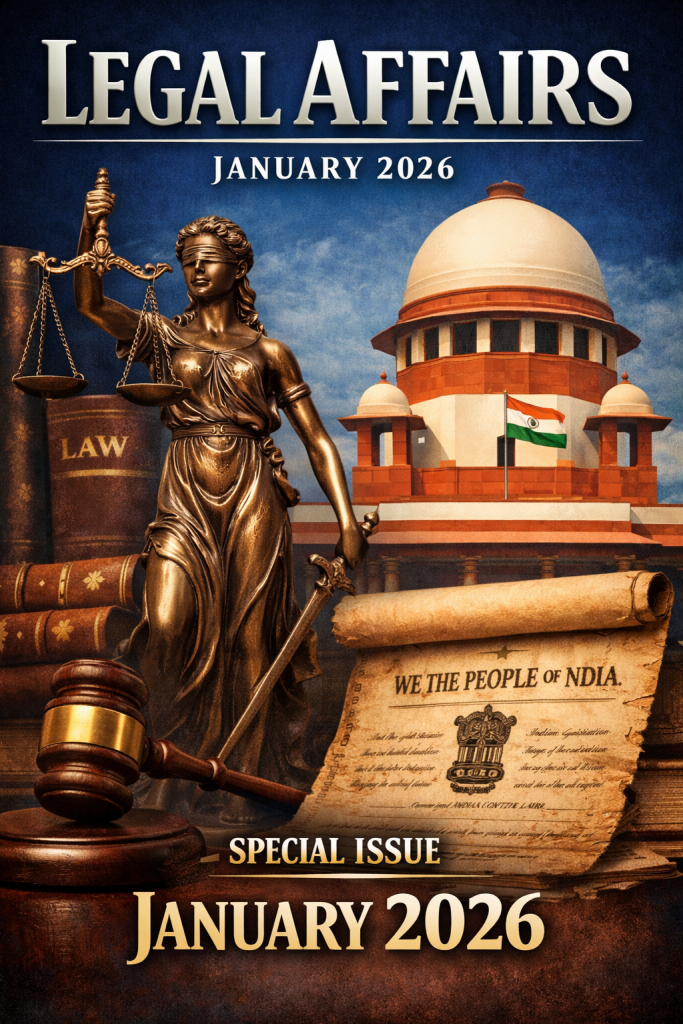
January 2026 Supreme Court Judgments brought landmark constitutional developments in India. The Court delivered important rulings on menstrual health as a fundamental right, UGC anti-discrimination regulations, UAPA bail jurisprudence, and women’s reservation in Bar Council elections. These judgments reinforce constitutional values of dignity, equality, liberty, and representation.
For official case status and judgments, visit the Supreme Court of India – Judgment Information System.
Right to Menstrual Health Recognised as a Fundamental Right
Dr. Jaya Thakur v. Government of India
In this January 2026 Supreme Court Judgments, the Supreme Court held that the right to menstrual health forms part of Article 21 of the Constitution, which guarantees the right to life with dignity. The Court noted that many schools still lack sanitary pads, separate toilets, and safe disposal facilities. As a result, adolescent girls miss school or even drop out, directly impacting education, equality, and dignity. The Court clarified that menstrual health is not just a welfare issue. It is a constitutional obligation connected to dignity, privacy, and bodily autonomy.
Constitutional Basis:
- Article 21 – Right to life with dignity
- Article 21A – Right to education
- Article 14 – Equality before law
Court Directions:
- Functional, gender-segregated toilets with water
- Free oxo-biodegradable sanitary napkins via vending machines
- Menstrual Hygiene Management (MHM) corners with spare supplies
- Safe disposal systems following solid waste management rules
- Inclusion of menstrual health education in NCERT & SCERT curricula
- Regular inspections and anonymous student feedback
- Oversight by NCPCR and SCPCR
Also Read: Landmark Supreme Court Judgements 2025
https://vidhigya.com/blog/landmark-supreme-court-judgements-2025/
Case reference: Full judgment on CaseMine
Supreme Court Halts UGC 2026 Regulations
Mritunjay Tiwari v. Union of India
On 13 January 2026, the UGC replaced the 2012 Equity Regulations with new 2026 Regulations. The Supreme Court found constitutional concerns. The Court observed that the new regulations:
- Narrowed the definition of caste-based discrimination
- Removed “ragging” as a recognised form of discrimination
- Created potential inequality under Articles 14 & 15
Interim Relief:
- 2026 Regulations kept in abeyance
- 2012 Regulations revived using Article 142
- Matter referred to a larger Bench
This judgment safeguards constitutional equality in higher education institutions.
Also Read: Supreme Court Rules: DNA Test Cannot Be Ordered When Paternity Question Lacks Nexus With Offence
Delhi Riots Case: Bail Ruling Under UAPA
Gulfisha Fatima v. State (NCT of Delhi)
In its 5 January 2026 ruling, the Supreme Court denied bail to Umar Khalid and Sharjeel Imam. At the same time, it granted conditional bail to five co-accused. The case concerns the February 2020 Northeast Delhi riots during protests against the Citizenship (Amendment) Act, 2019.
Legal Framework
- Section 15, UAPA – Defines terrorist acts, including non-violent acts that destabilise public order or economic security
- Section 43D(5), UAPA – Restricts bail
- Bharatiya Nyaya Sanhita (BNS) – Sections 189 & 191 define unlawful assembly and rioting
The Court reaffirmed the right to a speedy trial under Article 21, and held that five years’ detention was constitutionally permissible due to the complexity and gravity of the case.
Also Read: Supreme Court Reviews Doctors under Consumer Protection Act 2019
Women’s Reservation Extended to Punjab & Haryana Bar Council
In a petition by Advocate Yogamaya, the Supreme Court extended 30% reservation for women advocates to Punjab & Haryana Bar Council elections. Earlier, these states were exempted under the assumption that elections had begun. The Court clarified that only the voter list had been finalised and elections had not started.
Constitutional Basis:
- Article 14 – Equality before law
- Article 15 – Non-discrimination
- Article 21 – Dignity and meaningful participation
This ruling strengthens gender representation in the legal profession.