
By Janvi Patidar | Vidhigya
The Supreme Court has kept the Sabarimala review petitions pending and will consider them in April, after a larger bench examines key constitutional questions related to essential religious practices. The Court observed that whether courts can interfere in religious practices requires authoritative interpretation by a larger bench.
This means the final outcome of the Sabarimala review will depend on how these larger constitutional questions are settled. The decision is likely to impact several other cases involving religion and fundamental rights.
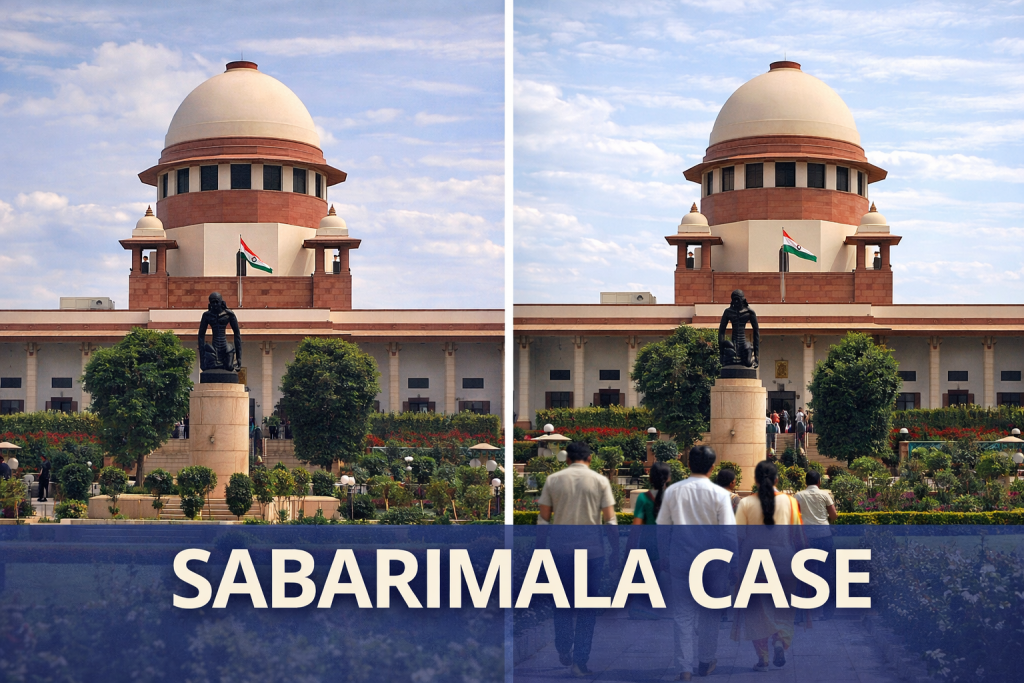
Why Are the Sabarimala Review Petitions Pending?
While hearing the review petitions, the Supreme Court noted that the matter goes beyond the Sabarimala dispute. The core issue is whether courts can examine what a religion claims to be its essential practice.
Since this question affects multiple religions and communities, the Court decided not to settle it within the limited scope of a review petition. Therefore, the Sabarimala review petitions will be taken up in April, after clarity emerges from the larger bench on these constitutional questions.
Dissent by Justices Chandrachud and Nariman
The minority opinion in the review proceedings was given by D. Y. Chandrachud and R. F. Nariman.
They dissented from the decision to tag broader issues with the Sabarimala review petitions. According to them, issues concerning Parsi women and Muslim women were not directly before the Sabarimala Bench. Therefore, these questions should not have been linked to the Sabarimala review proceedings.
Also Read: Landmark Supreme Court Judgements 2025 – https://vidhigya.com/blog/landmark-supreme-court-judgements-2025/
Nine-Judge Bench to Decide Larger Questions
In January 2020, the Supreme Court constituted a nine-judge bench to examine the broader constitutional issues arising from the Sabarimala review.
The 7 Questions Framed by the Supreme Court
The nine-judge bench framed seven key constitutional questions for final determination:
- Scope of the right to freedom of religion under Article 25
- Interplay between individual rights under Article 25 and denominational rights under Article 26
- Whether Article 26 rights are subject to other fundamental rights
- Meaning of “morality” under Articles 25 and 26 and whether it includes constitutional morality
- Extent of judicial review over religious practices
- Meaning of “Sections of Hindus” in Article 25(2)(b)
- Whether outsiders can challenge religious practices through PILs
These questions will decide the future framework for resolving disputes involving religion and fundamental rights.
Also Read: Supreme Court Reviews Doctors under Consumer Protection Act, 2019
https://vidhigya.com/blog/doctors-under-consumer-protection-act-2019/
Dawoodi Bohra Excommunication Issue Tagged in 2023
In February 2023, a Constitution Bench referred the issue of excommunication in the Dawoodi Bohra community to the same nine-judge bench constituted in the Sabarimala review.
This shows that the Supreme Court wants a single authoritative ruling on the scope of judicial review over religious practices across different communities.
Why This Case Matters
The final outcome of the Sabarimala review petitions, which are to be considered in April, will influence:
- The limits of judicial review in religious matters
- The balance between faith and fundamental rights
- The future of challenges to religious practices in courts
This decision will shape constitutional law on religion for years to come.
Case Title
Kantaru Rajeevaru v. Indian Young Lawyers Association & Ors.
R.P.(C) No. 3358/2018 in W.P.(C) No. 373/2006