By Janvi Patidar
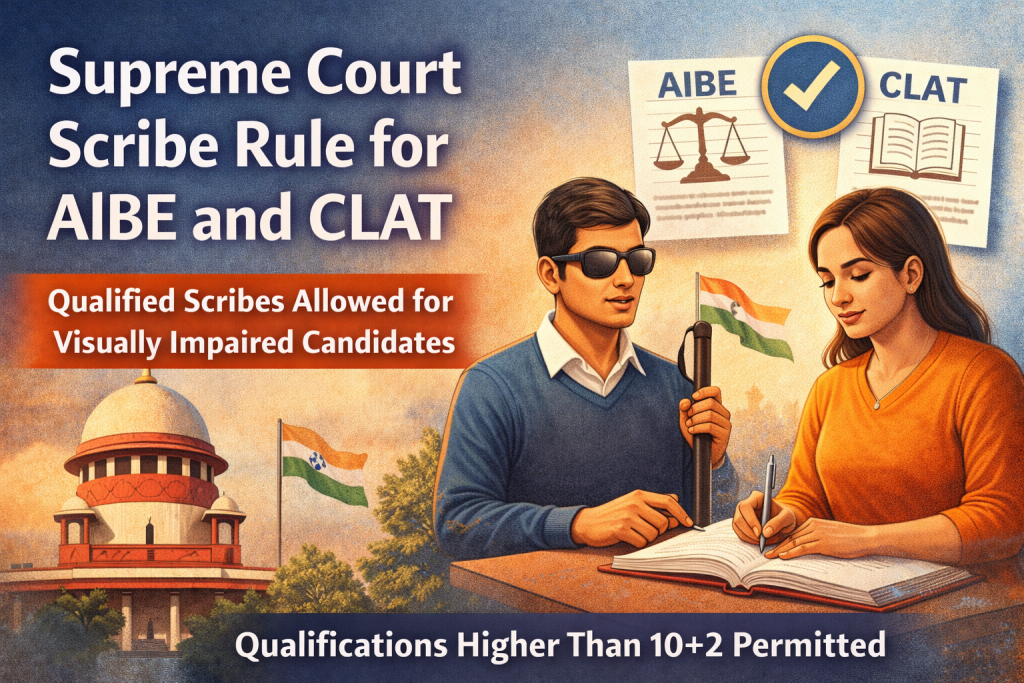
In a landmark step towards inclusive legal education and professional access, the Supreme Court scribe rule for AIBE and CLAT has brought major relief to visually impaired candidates. The Supreme Court has permitted candidates appearing in the All India Bar Examination (AIBE) and Common Law Admission Test (CLAT) to engage scribes who possess qualifications higher than 10+2, provided they are not law graduates.
A bench comprising:
- Chief Justice Surya Kant
- Justice Joymalya Bagchi
- Justice NV Anjaria
accepted the suggestions made by the petitioners.
The Court held:
“Visually impaired candidates appearing for AIBE are entitled to have assistance of a scribe who is an undergraduate and not pursuing law or humanities. There is no bar on a scribe having qualifications higher than 10+2 schooling“
This means:
✔ A scribe can be a graduate
✔ A scribe can have qualification beyond 12th
✔ But the scribe must NOT be a law graduate
✔ The scribe must not be pursuing law or humanities courses
This clarification is the core of the new Supreme Court scribe rule for AIBE and CLAT.
Directions Issued to Authorities
The Court directed:
- The Bar Council of India (BCI)
- The Consortium of National Law Universities (NLUs)
to formally notify and implement these changes before the next AIBE or CLAT examination.
Additionally:
- Respondents must file a compliance affidavit within two weeks.
- The matter is listed for next hearing on March 20, 2026.
The Court observed that the suggestions are consistent with guidelines issued by the Ministry of Social Justice and Empowerment.
Conclusion
The Supreme Court scribe rule for AIBE and CLAT marks a progressive step towards inclusivity in legal education and professional testing. By removing the rigid 10+2 qualification cap, the Court has ensured that visually impaired candidates can access competent scribes without unnecessary restrictions. This judgment reflects the Court’s commitment to fairness, equality, and accessibility in competitive examinations.
Cause Title:
Yash Dodani & Ors. v. Union of India & Ors.