By Janvi Patidar
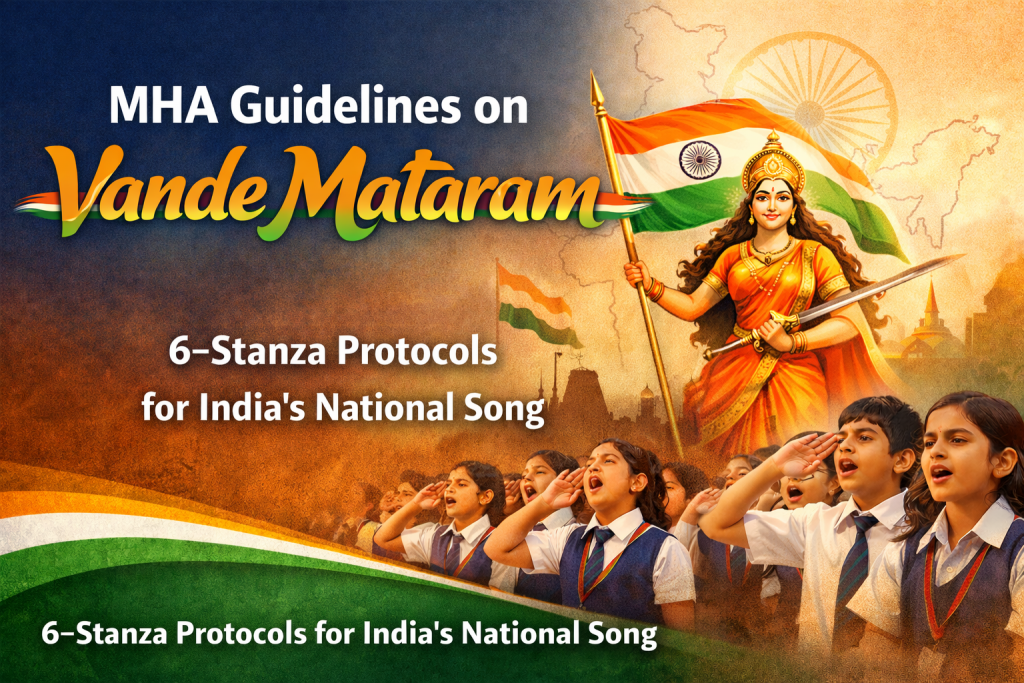
The Union Ministry of Home Affairs (MHA) recently issued the official MHA Guidelines on Vande Mataram, marking the 150th anniversary of India’s national song. These guidelines mandate that all six stanzas of Vande Mataram must be sung at official ceremonies, state functions, and school events, emphasizing patriotism, cultural heritage, and respect for the motherland.
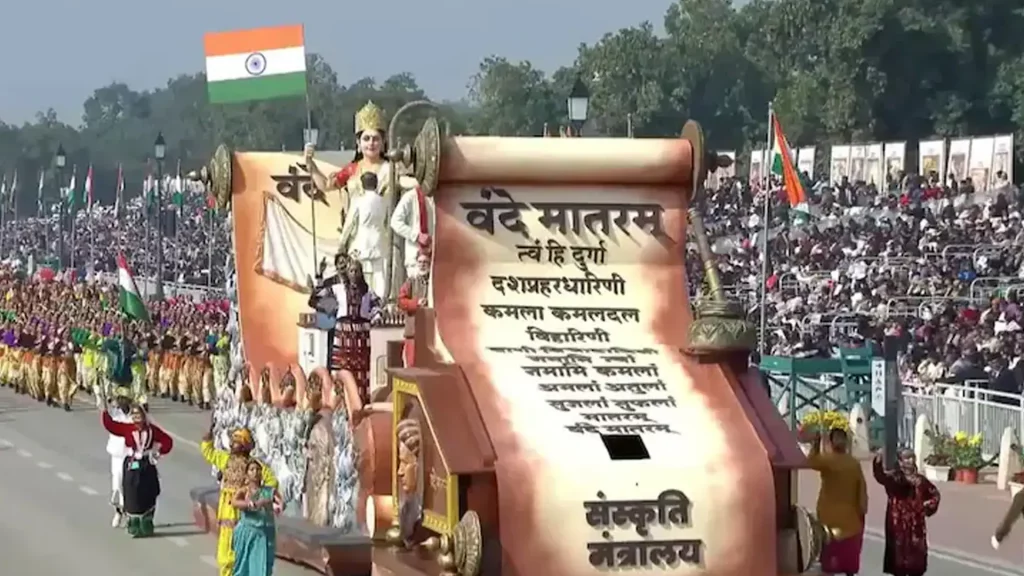
Key Occasions for Performing Vande Mataram
The MHA Guidelines on Vande Mataram specify the circumstances in which the National Song should be sung or played:
- Civil investiture ceremonies organized by the government.
- Arrival and departure of the President of India at state functions.
- Immediately before and after the President delivers an address via All India Radio or Doordarshan.
- During official functions when Governors or Lieutenant Governors arrive or depart.
- Flag ceremonies, when the National Flag is paraded.
- Additional occasions as directed by the Government of India.
When performed by ceremonial bands, the song should begin with a seven-step slow drumroll, unless otherwise instructed.
Mass Singing and School Participation
The MHA Guidelines on Vande Mataram also promote mass singing of Vande Mataram during:
- Flag hoisting ceremonies at cultural or ceremonial events (excluding parades).
- Arrival of the President at public functions outside formal state ceremonies.
- Schools are encouraged to start the day with Vande Mataram, fostering patriotism among students.
The MHA stresses that all six stanzas must be used in mass singing, and group participation should be promoted wherever possible. Educational institutions are further encouraged to raise awareness and respect for the National Song, National Anthem, and National Flag.
Also Read: Landmark Supreme Court Judgements 2025
About Vande Mataram
Vande Mataram, written by Bankim Chandra Chatterjee in the 1870s and published in the novel Anandamath in 1882, praises India as a motherland and symbolizes unity and patriotism. It played a crucial role during the freedom struggle and continues to represent national pride.
Key Facts:
- Language: Sanskrit and Bengali
- Total Stanzas: Six
- Adoption as National Song: Officially adopted by the Constituent Assembly on 24 January 1950
- Theme: Praises India as a divine mother and highlights natural beauty, strength, and cultural richness
- Role in Freedom Movement: Inspired freedom fighters and became a patriotic rallying cry
- Modern Usage: Performed at government ceremonies, cultural events, educational institutions, and patriotic programs
Historical Context:
Until recently, only the first two stanzas were performed officially. The MHA guidelines mark a shift, requiring all six stanzas to be sung during official ceremonies. The Centre’s January 28, 2026 order breaks with the practice initiated by the Congress leadership in 1937, which restricted official use to the first two stanzas due to objections from some sections of the Muslim community.
Also Read: Supreme Court Reviews Doctors under Consumer Protection Act 2019
6 Stanzas vs 2 Stanzas: The Controversy
- Stanzas 1-2: Describe the beauty and abundance of the motherland.
- Stanza 3: Crores of arms are ready to fight for India.
- Stanza 4: Crores ready to wield swords to protect the nation.
- Stanza 5: The image of the motherland is carved into temples and shrines.
- Stanza 6: Compares India to goddesses Durga, Lakshmi, and Saraswati.
The first two stanzas are now widely known, while the remaining four stanzas carry historical, martial, and religious symbolism. The MHA emphasizes that all six stanzas reflect the complete spirit of Vande Mataram.
Freedom Struggle Legacy:
- During the Swadeshi movement (1905–08), the song inspired countless Indians to rise against colonial rule.
- The Constituent Assembly granted Vande Mataram equal honor alongside the National Anthem in 1950.
- The song has historically represented national unity, even amid debates about religious content in the later stanzas.
Implementation Guidelines
The MHA instructions include:
- Official Ceremonies: Mandatory six-stanza rendition.
- Ceremonial Bands: Begin with a 7-step slow drumroll.
- Mass Singing: Encouraged in schools and public events.
- Educational Awareness: Schools to promote respect for the song, flag, and anthem.
Cultural Significance: The guidelines encourage citizens to participate actively, respecting Vande Mataram as a shared national heritage rather than a ceremonial formality.
Conclusion
The MHA guidelines on Vande Mataram provide clarity and uniformity in performing India’s National Song. By mandating all six stanzas, the government emphasizes historical accuracy, cultural respect, and national unity.
FAQ: Are the MHA Guidelines on Vande Mataram mandatory?
Answer: Yes, the MHA Guidelines on Vande Mataram require that all six stanzas of the national song be sung during official ceremonies, state events, and school programs to promote patriotism and respect for India.